Understanding what separates budget and premium PFAS filtration helps you choose based on your specific reduction goals.
- Budget certified filters provide meaningful reduction for drinking/cooking water at accessible cost.
- Premium systems provide more comprehensive coverage and typically higher capacity/longer media life.
- Choose based on whether comprehensive whole-home coverage matters for your specific goals.
- Both tiers must carry proper NSF/ANSI 53 or 58 certification regardless of price point.
Budget Certified Options
Basic certified activated carbon pitcher or faucet-mount filters ($30-$100) provide meaningful PFAS reduction for drinking/cooking water when properly certified.
The word doing the work in this category is certified, not budget. A pitcher or faucet-mount unit that carries a genuine NSF/ANSI 53 PFAS claim is performing against the same laboratory acceptance criterion as a far more expensive product making the same claim, and the certification does not scale with price.
What you give up at the lower price point is capacity and scope rather than certified reduction. Budget units tend to carry shorter rated capacities, which means more frequent replacement, and they only treat water at the single tap where they are fitted. Over several years the replacement cartridges typically cost more than the housing did.
The genuine risk at this price point is uncertified product that borrows the vocabulary of certification. Marketing copy referring to filtration technology, to carbon that is known to reduce PFAS, or to testing conducted to NSF standards is not the same as a listed certification. So is any product still advertising itself as NSF P473 certified, since that protocol was discontinued and folded into NSF/ANSI 53 and 58, making it outdated language rather than a current credential.
Premium Certified Options
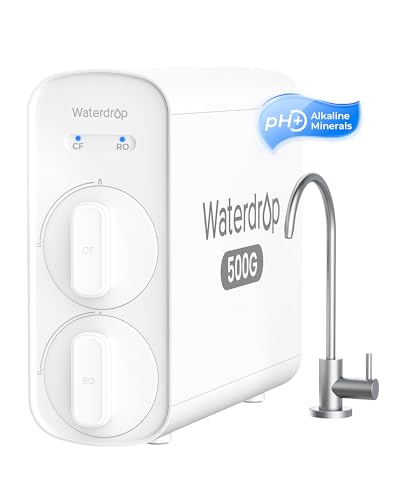
Reverse osmosis and whole-home ion exchange systems ($300-$2,000+) provide more comprehensive reduction across broader water use, along with typically longer media life and higher capacity.
The premium tier buys three things: broader coverage of PFAS compounds beyond PFOA and PFOS, higher throughput, and in the case of whole-home systems, treatment of water at every fixture rather than one tap.
Reverse osmosis earns its position here on mechanism rather than marketing. An RO membrane rejects contaminants largely by physical size exclusion, so it tends to give broader PFAS coverage than adsorption media that has to be validated compound by compound. That breadth is the practical reason RO appears so often in PFAS guidance, and it is certified under NSF/ANSI 58 rather than 53.
The costs premium buyers underestimate are installation and ongoing operation rather than the purchase price. Under-sink RO needs a drain connection and a dedicated faucet, produces some volume of reject water per gallon of treated water, and carries a multi-stage replacement schedule where the pre-filters, post-filter and membrane all run on different intervals. Whole-home ion exchange adds pressure tanks, bypass valves and, depending on your local code, backflow prevention.

Choosing Based on Your Goals
Choose premium if comprehensive whole-home coverage matters to you; budget certified options are entirely adequate for drinking/cooking water-focused prevention.
Anchor the decision to your testing results rather than to the price tiers. If your water has been tested and PFAS is either non-detect or well below the level that concerns you, a certified point-of-use filter at the kitchen tap is a proportionate response, and the money saved is better spent on periodic retesting.
One detail deserves attention at both price points, because it is not obvious and it is not usually disclosed in product marketing. The NSF/ANSI acceptance criterion for a PFAS reduction claim is bringing combined PFOA and PFOS down to 20 ppt or below from a defined challenge concentration. The EPA’s enforceable limit is 4.0 ppt for each of PFOA and PFOS individually, which is substantially stricter [1]. A certified filter is therefore proven to reduce PFAS meaningfully, but certification alone is not a guarantee that your treated water sits below the federal limit if your incoming water is heavily contaminated.
That gap is the strongest practical argument for testing your treated water rather than relying on the certification label, and it applies with more force the higher your untreated concentration is. In a lightly affected area it is close to academic. On a private well with a high measured result, it is the whole question.
FAQ
Is a premium reverse osmosis system meaningfully better than a budget pitcher filter?
For comprehensive whole-home coverage, yes — but for drinking/cooking water specifically, a properly certified budget option provides meaningful reduction at lower cost.
Does a more expensive filter reduce PFAS further than a cheap certified one?
Not necessarily on a per-compound basis, because both are validated against the same acceptance criterion. What the higher price generally buys is coverage of more PFAS compounds, greater rated capacity, and treatment at more than one tap.
What does a PFAS certification actually prove?
That the unit brought combined PFOA and PFOS down to 20 ppt or below from a defined laboratory challenge concentration, under NSF/ANSI 53 or 58. It is a meaningful, independently verified reduction claim, and it is a looser threshold than the EPA’s 4.0 ppt enforceable limit.
Is a product advertising NSF P473 certification still trustworthy?
The claim is outdated rather than automatically false, since P473 was discontinued and absorbed into NSF/ANSI 53 and 58. Treat it as a prompt to look the product up in the certifier’s own database and confirm what it is currently listed for.
How do I confirm a certification is real?
Search the product in the certifier’s public listing directory rather than trusting the box. NSF publishes its certified drinking water treatment units at info.nsf.org/Certified/DWTU, and WQA’s Gold Seal programme is ANSI-accredited to the same NSF/ANSI standards.
Verify NSF/ANSI 53 or 58 certification on any product regardless of price tier — this matters more than the budget-vs-premium distinction.
References
- Per- and Polyfluoroalkyl Substances (PFAS). U.S. Environmental Protection Agency
These statements have not been evaluated by the Food and Drug Administration. This information is not intended to diagnose, treat, cure, or prevent any disease. Content is for informational purposes only and is not medical advice; consult a qualified healthcare provider before starting any supplement. As an Amazon Associate we earn from qualifying purchases.
