Since this is generally a discretionary, non-urgent purchase, there’s ample room to negotiate and compare before committing.
- Labor pricing can often be negotiated given multiple quotes and this purchase’s generally non-urgent nature.
- Compare bundled packages against itemized quotes to find the best overall value.
- Use multiple quotes as leverage without feeling pressured to decide quickly.
- This discretionary purchase gives you ample room and time to negotiate favorably.
Room for Negotiation
Labor pricing for whole-home system installation can often be negotiated, particularly with multiple quotes gathered for comparison.
Before any figure is discussed it is worth knowing that federal law already puts a floor under this conversation. The FTC’s Cooling-Off Rule gives a buyer three days to cancel certain sales made at home, at a workplace or dormitory, or at a seller’s temporary location such as a hotel room or a convention center, and it applies specifically when you invite a salesperson to make a presentation in your home[1]. For sales made at your home the rule covers purchases of $25 or more, so a whole-home treatment quote sits comfortably inside its scope[1].
The counting is precise enough to be worth getting right. The right to cancel for a full refund runs until midnight of the third business day after the sale; Saturday counts as a business day, and Sundays and federal holidays do not[1]. A contract signed on a Monday in a week with no federal holiday can be cancelled until midnight on Thursday, while one signed on a Friday runs to midnight on Tuesday[1]. No reason has to be given, because the rule treats changing your mind as sufficient on its own[1].
The rule places obligations on the seller too, and those make a useful character test during the pitch. At the time of sale the seller must tell you about the right to cancel and hand over two copies of a cancellation form, one to keep and one to return, along with a dated contract or receipt showing the seller’s name and address and explaining that right[1]. The contract has to be in the same language that was used in the sales presentation[1]. A company that supplies none of this during a high-pressure pitch has already said something about how the rest of the job is likely to go.
The exceptions matter as much as the rule, and one of them is easy to walk into. The Cooling-Off Rule does not cover a sale completed after negotiations at the seller’s permanent place of business, a sale made entirely online, by mail or by telephone, or a sale that happened because you asked the seller to come out and repair or maintain property you already own[1]. Anything bought beyond that original repair request is still covered[1]. So a service call that turns into a system sale can produce one line that is cancellable and another that is not.
Comparing Bundled Packages
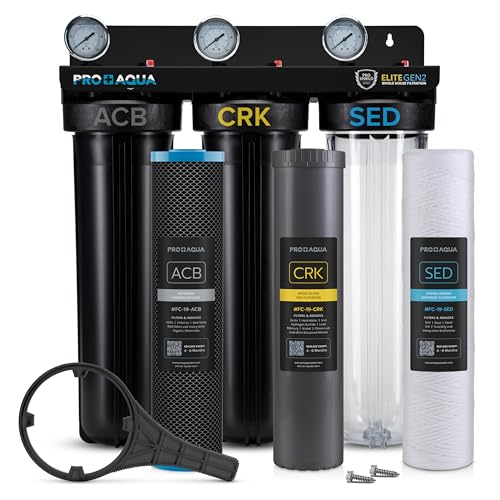
Some companies bundle system, installation, initial media, and testing into a package price — compare this against itemized quotes to find the best overall value.
A bundle is harder to compare than an itemized quote for a specific reason: it collapses a very wide range into a single number. EPA describes home filtration as a price spectrum rather than a price, running from as little as $20 to more than $1,000 before maintenance, with the variation driven by type, brand, and whether the unit is a pitcher, a faucet-mounted filter or a whole-home system[2]. Two bundles quoting a similar total can sit at opposite ends of that spectrum.
The line most worth isolating is the one bundles tend to fold away. EPA is direct that filters are only effective if they are maintained according to the manufacturer’s instructions, and that not replacing a filter on the recommended schedule can increase your risk of exposure to PFAS[2]. It also notes that maintenance and disposal costs vary between filters and sit outside the purchase price entirely[2]. A package that includes initial media is quoting you the cheapest cartridge you will ever buy for that system.
Testing is the other line worth pulling out and pricing on its own. If the property draws from a private well, EPA recommends testing annually for total coliform bacteria, nitrates, total dissolved solids and pH, and advises testing immediately after any part of the well system is replaced or repaired[3]. An installation is exactly that kind of change, which makes post-installation verification a real deliverable rather than an upsell, and it belongs on the quote as its own line.

Effective Negotiation Approach
Use multiple quotes as leverage for reasonable price negotiation, and don’t feel pressured to decide quickly given this purchase’s generally discretionary, non-urgent nature.
The most productive thing to negotiate is the specification rather than the total. EPA’s test for whether a filter addresses PFAS at all is concrete: check the product packaging for certification to NSF/ANSI 53 or NSF/ANSI 58 for PFAS reduction, and if the packaging is unclear, look the product up in the certification body’s own product directory[2]. Five ANSI-accredited third-party bodies certify drinking water filters for PFAS reduction, namely CSA Group, IAPMO R&T, NSF, UL and WQA, each with a registered mark and a searchable product listing[2].
Asking for the certified model number in writing costs nothing and converts a verbal claim into something checkable before the cancellation window closes. EPA notes that PFAS reduction claims may appear on outer packaging, in a performance data sheet inside the package, or on the manufacturer’s website[2], so a contractor who cannot point to any of the three is describing a category rather than a product.
One claim deserves skepticism no matter where the price lands. As of April 2024, filter certifications focused on PFOA and PFOS specifically, and EPA states that the current certification standards do not yet indicate that a filter will remove PFAS down to the levels it has now set for a drinking water standard[2]. Reducing PFAS levels is still an effective way to limit exposure, and EPA says so in the same breath[2], but a quote promising removal to federal limits is claiming more than the certification behind the product currently supports.
If the decision does need reversing, the mechanics reward knowing them in advance. Sign and date one copy of the cancellation form and mail it so the envelope is postmarked before midnight of the third business day; if the seller never supplied forms, a letter postmarked inside the same window does the same job[1]. Sending it by certified mail produces a return receipt, which is proof of when it was sent and when it arrived[1]. After a valid cancellation the seller has 10 days to refund payments and return any trade-in, and 20 days to collect anything left at the house or reimburse the cost of shipping it back[1].
FAQ
Is it reasonable to negotiate on a PFAS treatment installation quote?
Yes — given this is generally a discretionary, non-urgent purchase, you have ample room to gather multiple quotes and negotiate reasonably.
References
- Buyer’s Remorse: The FTC’s Cooling-Off Rule May Help. U.S. Federal Trade Commission
- Reducing PFAS in Your Drinking Water with a Home Filter (fact sheet, April 2024). U.S. Environmental Protection Agency
- Protect Your Home’s Water. U.S. Environmental Protection Agency, Private Drinking Water Wells
Take your time comparing quotes given this purchase’s generally discretionary nature, unless you’re in a documented urgent contamination situation.
These statements have not been evaluated by the Food and Drug Administration. This information is not intended to diagnose, treat, cure, or prevent any disease. Content is for informational purposes only and is not medical advice; consult a qualified healthcare provider before starting any supplement. As an Amazon Associate we earn from qualifying purchases.