New construction offers the opportunity to integrate PFAS-specific filtration into initial plumbing design.
- Built-in filtration during initial construction is often more cost-efficient than later retrofitting.
- Check your target municipal utility’s PFAS history or plan for well testing before finalizing construction plans.
- Weigh this alongside cost and other new-construction priorities.
- Prioritize more heavily if building in a documented contamination area.
Built-In Filtration During Initial Construction
Building in certified PFAS filtration during initial plumbing installation is often more cost-efficient than retrofitting it into an already-built home.
The shortlist of technologies worth roughing in for is short. EPA names three that are currently available and can be effective at reducing PFAS: granular activated carbon, which uses carbon to trap chemicals as water passes through it; reverse osmosis, which forces water through an extremely thin barrier that separates chemicals from the water; and ion exchange resins, tiny beads that act like powerful magnets attracting and holding the contaminated material[1]. Each carries different plumbing consequences around drain lines, pressure and service access, which is exactly the class of decision that is cheap at rough-in and expensive afterwards.
The decision should be sized to the water the house will actually receive rather than to the category in the abstract. EPA’s first instruction to anyone considering a filter is to contact the local water provider to find out which PFAS, if any, are in the supply, and to search its database of PFAS water system test results or its map-based PFAS Analytic Tools[1]. It adds that a state environmental protection agency or health department may hold further information and recommendations for the area[1].
EPA is also willing to say when a filter is not warranted, which is unusual and genuinely useful at design stage: if PFAS have not been measured in the water, or have been measured but are below federal limits, a filter may not be useful[1]. During construction that converts cleanly into a plan. Rough in the space, the stub-outs and the drain, then let the test result decide whether the unit is installed at all.
Checking Municipal Source Before Building
Check your target municipal water utility’s PFAS testing history (or plan for well testing if applicable) before finalizing new construction plans in a specific area.
If the lot will draw from a private well rather than a municipal main, the testing burden sits with the household from the first day, and EPA’s well guidance is worth reading before the drill rig arrives. It recommends testing annually for total coliform bacteria, nitrates, total dissolved solids and pH levels, and testing for any other substance suspected to be present, which a local health department can advise on for the area[2].
One of the triggers EPA lists for immediate testing speaks directly to this situation. It advises testing right away when conditions near the well have changed significantly, and names flooding, land disturbances, and new construction or industrial activity as examples[2]. A new build is itself a land disturbance. EPA separately advises testing immediately whenever any part of the well system is replaced or repaired[2], which on a newly drilled well is the entire system.
Site conditions map onto specific tests, and the ones worth raising with a driller are those EPA ties to a nearby land use. A dump, junkyard, landfill, factory, gas station or dry-cleaning operation nearby points to volatile organic compounds, total dissolved solids, pH, sulfate, chloride and metals[2]. Household plumbing or service lines that contain lead point instead to pH, lead and copper[2].
Two further points belong in the build schedule rather than in a folder. EPA says to use only laboratories that are certified to do drinking water testing, and notes that a local health department may provide private well testing free of charge[2]. It also advises testing more frequently where small children or elderly adults live in the house, or where someone is pregnant or nursing, since those groups are often more vulnerable to pollutants than others[2]. For a family home that is a standing schedule, not a one-off commissioning check.
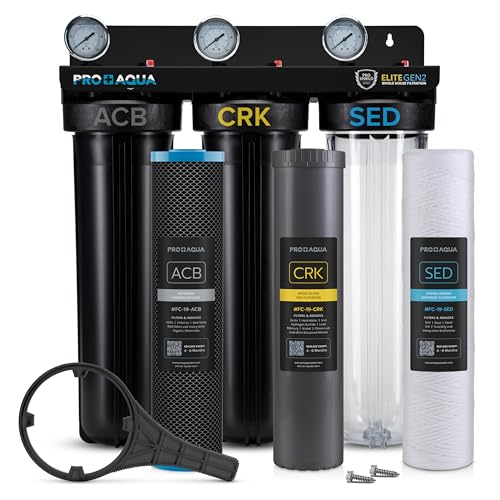
Weighing This Alongside Other Build Priorities
This is one of many system decisions in new construction — weigh it alongside cost and other priorities, prioritizing more heavily in documented contamination areas.
Cost is the usual reason this slips down the list, and EPA’s own range shows how wide the decision really is: a filter can cost as little as $20 or more than $1,000 before maintenance, varying by type, by brand, and by whether it is a pitcher, a faucet-mounted unit or a whole-home system[1]. Against a construction budget the point-of-use end is close to a rounding error, while the whole-home end is a genuine line item, and that is the one that benefits from being settled at design rather than at move-in.
Whatever gets specified, settle the certification question on paper before anything is installed. EPA’s test is certification to NSF/ANSI 53 or NSF/ANSI 58 for PFAS reduction, verified against the certification body’s product directory when the packaging is unclear[1]. Five ANSI-accredited bodies certify drinking water filters for PFAS reduction, namely CSA Group, IAPMO R&T, NSF, UL and WQA[1]. A builder’s allowance that names a certified model is worth considerably more than one that names a category.
One consumer-protection point does not transfer to this situation, and it is better to know that in advance than to assume it. The FTC’s Cooling-Off Rule, which gives three business days to cancel certain sales made at a buyer’s home, does not cover a sale completed after negotiations at the seller’s permanent place of business[3]. A build contract signed in a builder’s sales office therefore falls outside it, even though a treatment system sold to the same household at the door later would not. State laws can give more rights than the federal rule, and a state attorney general or local consumer protection office can say what applies[3].
There is one maintenance decision that outlasts the build. EPA states that filters are only effective if they are maintained according to the manufacturer’s instructions, and that not replacing a filter on the recommended schedule can increase the risk of exposure to PFAS[1]. On a new house that argues for locating the unit where a cartridge can actually be changed without moving anything else, which is a design decision rather than a maintenance one.

FAQ
Should I request PFAS filtration when building new?
It’s cost-efficient to integrate during initial plumbing installation — worth discussing with your builder, especially if you’re building in an area with any documented contamination concern.
References
- Reducing PFAS in Your Drinking Water with a Home Filter (fact sheet, April 2024). U.S. Environmental Protection Agency
- Protect Your Home’s Water. U.S. Environmental Protection Agency, Private Drinking Water Wells
- Buyer’s Remorse: The FTC’s Cooling-Off Rule May Help. U.S. Federal Trade Commission
Check your target area’s documented contamination status before finalizing new construction plans.
These statements have not been evaluated by the Food and Drug Administration. This information is not intended to diagnose, treat, cure, or prevent any disease. Content is for informational purposes only and is not medical advice; consult a qualified healthcare provider before starting any supplement. As an Amazon Associate we earn from qualifying purchases.
